
Inspirational
“She’s Not Dead” Poor Orphan Stops Billionaire Funeral To Save Her, what happened next

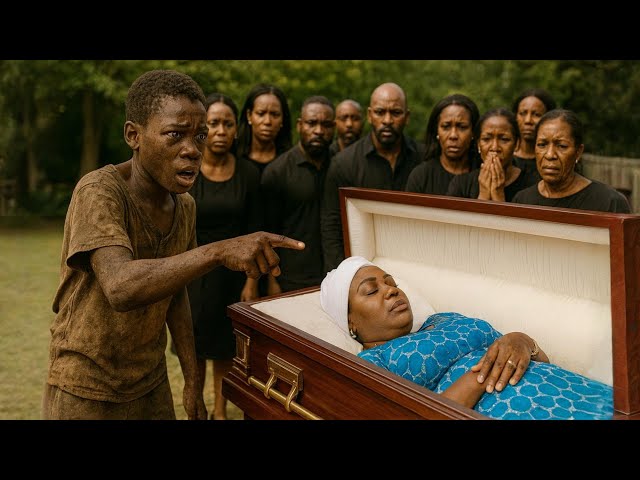
Ibuka was a 12-year-old orphan who lived on the streets of Aoyi, in Lagos. He was small for his age, with thin arms and bright, sharp eyes that noticed everything. While other children went to school in clean uniforms, Ibuka woke up under an abandoned kiosk near a big mango tree. That was his “room.” He washed his face with a little water, picked up his dirty black tray, and went out to sell sachets of water by the roadside.
His parents had died when he was very young. Since then, he had no home, no family, and no one to care if he ate or not. Every day he shouted to passing cars, begging them to buy water so he could get enough money to eat something. He had learned how to smile even when his stomach was empty, how to run when police chased street kids, and how to keep quiet when people insulted him. Still, he believed there were kind people in the world.
Most days, Ibuka sold water near a tall white gate on Bordeon Road. Behind that gate was a mansion that looked like a palace. Marble walls, tall pillars, shining cars and a big compound. It belonged to Madame Chica, one of the richest women in Lagos. When her cars drove in and out, Ibuka would stare and imagine what it felt like to sleep on a soft bed, eat hot food, and never worry about the rain at night.
The security guards often shouted at him.
“Go away, boy. Don’t stand near this gate.”
Ibuka would smile and say quietly, “I’m not stealing, sir. I’m only selling water.”
He did not know that someone was watching him from upstairs. Madame Chica had seen him many times through her window. She noticed how small he looked, how tired his legs were, and how he greeted everyone, even when they ignored him.
One day, as her car was about to drive out, she asked her driver, Mr. Okoro, to stop. She rolled down the window.
“Come here, young man.”
Ibuka froze. Someone inside the mansion was talking to him. He ran to the car, holding his tray tightly.
“Good afternoon, Ma,” he said, shaking.
“What’s your name?” she asked.
“Ibuka, Ma.”
“And your parents?”
“They are gone, Ma. It’s just me.”
His answer touched her heart. She gave him money and told him, “Buy yourself food and don’t stand under this hot sun all day, okay?”
Ibuka nodded, fighting tears. That day he ate proper fried rice from a restaurant for the first time in years. From that moment, he began to call her “Mama Chica” in his heart.
Days passed. Each time her car went out, she waved at him. Sometimes she sent Mr. Okoro to give him leftover food. Slowly, the guards stopped shouting at him because they saw he meant something to her. But not everyone in the mansion liked that.
One evening, Ibuka sat by the fence counting his coins. The gate was slightly open, and he heard voices from inside. A man was shouting.
“You are wasting our family money, Auntie. You keep giving money to strangers and beggars. What about your own blood?”
That was Chief Damian, Madame Chica’s nephew. He was tall, proud, and always acted like he deserved everything.
Madame Chica replied calmly, “Damian, what I do with my money is my choice. I built this business from nothing. I will help whoever I want to help.”
He mocked her. “You call feeding street rats help? They’ll never remember you when you’re gone. Family should come first.”
“Family should love first, Damian,” she answered softly, “not beg first.”
Outside, Ibuka smiled. “Mama Chica has a good heart,” he whispered.
Later, Mr. Okoro came out and saw Ibuka.
“You remind Madam of her late son,” he said. “He died when he was about your age. Her heart has never been the same.”
Ibuka looked at the mansion and felt a new connection with her. She had lost a child; he had lost parents. Pain linked them.
The next day, the mansion was unusually busy. Many cars arrived. People in fine clothes went in. Music and laughter filled the air. Ibuka asked Mr. Okoro what was happening.
“It’s a family meeting. Madam wants to share some company shares among her relatives,” the driver said.
Ibuka sat outside, feeling uneasy, though he didn’t know why.
Inside, relatives sat around a long glass table. They smiled, but their eyes were greedy. Chief Damian sat close to her, watching the documents instead of her face. Madame Chica reminded them that wealth meant nothing without love and peace in the family. She looked tired and mentioned a headache, but continued the meeting.
Outside, Ibuka waited for hours. The sun went down. Suddenly, he heard a crash and screams. He ran to the gate and peeped in. He saw people rushing around. Madame Chica was on the floor. Her teacup had shattered beside her. The tea was spilled on the tiles.
“She fainted!” people shouted.
Chief Damian pretended to panic, yelling for a doctor, but Ibuka saw fear in his eyes when he glanced at the cup.
Ibuka spotted a small movement in her hand.
“She’s not dead,” he cried, but the guards dragged him out and shut the gate.
An ambulance came. They carried her away, pale and still. Mr. Okoro told Ibuka sadly that she didn’t make it, that the doctor said she was gone. But Ibuka refused to believe it.
“I saw her fingers move,” he kept saying. That night he slept under the mango tree, whispering, “She’s not dead. I know it.” He felt deep inside that her story wasn’t over.
The next day, the mansion was filled with white ribbons and wreaths. They were preparing for the burial. People talked about her wealth, not her kindness. Ibuka sat with one sachet of water in his hand, whispering her name and promising to wait for her.
Soon, the funeral began. White tents, gold ribbons, a big framed photo and in the center a golden casket. Chief Damian walked around with a fake sad face, shaking hands and acting important. Behind the act, he wanted one thing: control of her wealth. His lawyer informed him that once she was buried, her shares would be his.
A nurse named Amara walked around serving water. She had been hired just for the funeral. When she passed the casket, something in her heart felt wrong, but she brushed it aside.
Outside, Ibuka tried to see what was happening. There were too many people and police at the gate. He squeezed through a gap, crawled behind cars, and hid near a flower bed where he could see the casket clearly. As the priest prayed, Ibuka’s chest tightened.
“They can’t bury her,” he whispered. “She’s not gone.”
He spotted Mr. Okoro and rushed to him secretly.
“You believe me, don’t you?” Ibuka begged. “That night her fingers moved.”
The driver was torn. He wanted to believe the boy, but the doctor had declared her dead.
“They are about to take her to the graveyard,” he said.
“Please let me try. Just let me touch the casket,” Ibuka begged.
Finally, Mr. Okoro agreed to distract the guards. When he waved, Ibuka ran through a side gate and entered the compound, hiding behind chairs. The men in black suits lifted the casket and started towards the hearse. Just then a guard saw Ibuka.
“Hey, what are you doing here?”
Ibuka jumped up and shouted with all his strength, “Wait! She’s not dead! I saw her hand move. Please don’t bury her!”
Chaos followed. People gasped. Cameras turned. Chief Damian ordered them to grab him, but the boy begged them to check her one more time.
Nurse Amara stepped forward.
“Let me check,” she said.
Damian tried to block her, but too many eyes were watching. He forced a smile and allowed it. Amara touched Madame Chica’s neck, then her wrist. For a moment she felt nothing. Then she felt a tiny flutter.
Her eyes widened. “She’s alive,” she whispered, then said it louder. “She’s alive! We need an ambulance now!”
The crowd screamed. Some people fainted. The casket was no longer a symbol of death. It was proof of a terrible mistake—or something worse.
An ambulance arrived and carried Madame Chica to the hospital. Ibuka tried to follow but was pushed out. That night, while people gossiped and the mansion grew quiet, Ibuka stayed near the gate, watching, thinking. When the guards moved away, he slipped back inside, followed his instincts and ended up near a back room where he heard voices.
Chief Damian was speaking angrily to Dr. Okachukwu, the family doctor.
“I told you to make sure she was gone,” Damian hissed.
The doctor admitted he had given an injection that slowed her heart almost to a stop. They thought she was dead, but the effect was temporary.
“You’ll go to the hospital tomorrow and finish it,” Damian ordered. “She must never wake up.”
Ibuka’s heart raced. He accidentally knocked over a metal tray. They shouted and chased him, but he escaped. He ran through the night to a small roadside clinic where Nurse Amara worked.
Breathing hard, he told her everything he heard. At first she was shocked, then serious. She knew they couldn’t simply accuse a rich man and a respected doctor without proof.
“We need evidence,” she said. “I work at that hospital. I’ll be on duty. You’re small enough to hide. Between the two of us, we’ll watch them.”
The next night, Dr. Okachukwu came to the hospital carrying a syringe. Amara tried to question him. He claimed it was vitamins. Ibuka, who had sneaked in, confronted him. The doctor denied everything and called security, but Amara protected Ibuka and warned the doctor that she would report him.
After that, they knew he would be more careful. So Amara used a small recording device hidden behind a flower pot when Chief Damian came to visit. She served him tea and secretly recorded him saying, “Let’s hope she doesn’t wake up too soon. Some people may not be ready for her stories.”
It wasn’t a full confession, but it proved he didn’t want her to wake up. Amara shared the recording with a young journalist named Ejoma. They planned to gather more evidence, but before they could act, things got worse.
At night, two men broke into Ejoma’s house. They kidnapped both her and Ibuka and took them back to the mansion. Damian was moving fast. With help from the doctor, he had declared Madame Chica “dead” again after pushing her into a deeper coma. A secret second burial was arranged. No media, no big crowd, just a few workers, a fake priest and some relatives.
Ibuka and Ejoma were tied up in a room. Their phones were destroyed. It looked hopeless until Mr. Okoro sneaked in, cut their ropes and told them the second burial was about to start.
“We have to stop them again,” Ibuka said.
The driver was afraid for him, but Ibuka said, “The first time I was just a street boy. Now people know who I am.”
He ran out into the compound just as the workers picked up the golden casket again.
“Stop!” he shouted, standing in front of it. “She’s still breathing!”
Some relatives began to whisper. Damian tried to dismiss him as a mad child, but then Nurse Amara arrived, holding her phone.
“Touch him and the whole world will hear what you did,” she said. She played the recording of Damian’s voice. People listened in shock.
At that moment, Inspector Olum and police officers entered the compound. They had been informed and had enough evidence to stop the burial. The inspector ordered the casket opened. Inside, Madame Chica was still breathing, faint but alive.
The crowd turned against Damian and the doctor. Police arrested them both on the spot. News spread quickly: a billionaire found alive in her coffin, nephew and doctor arrested, street boy saves her again.
Madame Chica was moved to a better hospital, Hope Memorial. Doctors discovered she had been given a drug that almost stopped her heart. She was in a coma but responding slowly. Ibuka stayed by her side day and night. He held her hand and spoke to her, telling her she was safe.
“You were the only one who saw me,” he whispered. “I won’t leave you.”
Days passed. One day, her fingers moved and she whispered, “Water.” Amara gave her a little. Later she fully woke up and asked, “Where is the boy? Where is Ibuka?”
When he entered the room, she smiled weakly and said, “My boy.” He broke down crying as she told him, “I heard you in the dark. You brought me back. You are my miracle. My son.”
Soon the whole country waited to hear from her. A press conference was arranged in the hospital boardroom. Journalists, cameras, and police filled the room. Madame Chica was wheeled in, Ibuka at her side.
Her first words were clear and strong: “I was not dead. I was poisoned by my own nephew.” She explained how Damian had tried to bury her alive to steal her wealth. Then she pointed to Ibuka.
“This boy, a street child, is the reason I am alive. He saw what others didn’t. He shouted when everyone else was quiet. He stopped them twice. Not my doctor, not my family—this boy.”
Then she said something that shocked everyone: “From today, Ibuka is no longer just a boy on the street. I call him my son. I will adopt him legally. He will carry my name and he will never suffer again.”
People clapped, cried and praised her courage. On TV and radio, people talked about how a small boy had saved a billionaire and how she chose love over blood.
In prison, Damian watched the news in silence. He realized he had lost everything. Even the doctor regretted joining the evil plan.
Back at the hospital, Ibuka asked her quietly, “You really want to adopt me?”
“I meant every word,” she said. “I was once like you. I lost my parents at 14 and sold bread on the streets. I built my life from pain. What matters is not where you start, but who you become.”
She also thanked Amara for risking her job and made her head of her hospital foundation. Together they planned a future built on truth, not greed.
Madame Chica recovered fully and returned to her mansion. Ibuka moved in with her. The same gate where he once stood selling water now opened for him as a son of the house. But he did not become proud. He still greeted the cleaners, thanked the cook, and helped the gate man. When Mr. Okoro teased him that he was “the same Ibuka, only cleaner now,” he laughed and said he still felt like the boy from under the mango tree.
Damian’s trial went ahead. The evidence was strong: the recordings, the medical reports, the syringe, the witness statements. He was found guilty. Madame Chica did not seek revenge; she simply let the law do its work and focused on healing her heart and helping others.
She created a charity called The Ibuka Life Foundation. Its purpose was to find children like Ibuka—homeless, voiceless, forgotten—and give them food, education, and a chance at a new life. At the opening, Ibuka spoke to the crowd.
“I had no father, no mother. I was hungry and slept outside. But I did not give up. One day someone saw me—Mama Chica. She gave me food, then love, then her name. If you feel small and forgotten, don’t lose hope. Someone will see you. And if you see someone else suffering, don’t look away. You might be the one who saves them.”
People cried and clapped. His words were simple but full of truth.
Later, Ibuka went back to the mango tree where he used to sleep. He sat under it in clean clothes, remembering the nights he spent there cold and hungry. A small boy selling groundnuts approached him. Ibuka gave him money for food and asked him to come back, wanting to talk more. He saw himself in that boy and knew his work was only beginning.
Back at the mansion that evening, he told Madame Chica where he had gone. She said it was good he hadn’t forgotten his past. He asked her why she had chosen to help him among all the street children.
“Because you looked at me like I was human,” she said. “Not like a bank, not like a celebrity, but like a person. I saw pain in your eyes, but I also saw hope. I knew you were different.”
“You made me feel like I mattered,” he said softly.
“You do matter,” she replied, hugging him.
Soon after, she called a meeting at her company. Staff, partners, and directors filled the hall. They expected business talk. Instead, she walked in holding Ibuka’s hand and announced:
“This is your new Director of Youth and Community Impact.”
Some people were shocked. A boy who used to sell water now had a director’s title. But she explained:
“He did what many of you could not. He saw what others missed. He stood for what was right when everyone else was afraid. If we don’t build a future that includes people like him, what are we building?”
Slowly, everyone stood and clapped. Ibuka shook with emotion. That night he wrote in his notebook, “Today I became someone new. But I will never forget the boy I was.”
He looked out at the city lights and thought about all the children still on the streets. He knew his story wasn’t just about being saved. It was about using his new voice, his new name, and his new life to make sure that when another small boy shouts, “She’s still breathing,” the world will listen.